
Introduction: The Resume Is Dying, But the Replacement Isn't a Better Resume
Over the past five years, AI CV screening has evolved rapidly—from basic keyword matching to semantic understanding, and now to LLM-powered evaluation with explainability. Yet one fundamental flaw has remained untouched: every AI CV screening system analyzes a snapshot frozen at the moment of application submission.
The moment a candidate submits their resume is the moment that data starts becoming obsolete. Their skills are updating, their career trajectory is extending, and their attitude toward opportunities is shifting. But traditional ATS platforms and the vast majority of AI screening tools are powerless here—their database architecture has no place to store a "career trajectory model," no mechanism to compute a "contextual fit score," and no closed loop to continuously learn from every hiring outcome.
This is the backdrop against which the concept of the "Candidate Digital Twin" enters the picture. It represents not just a technical upgrade, but a paradigm shift: from "who was this person when they applied" to "who is this person now, and what would they say yes to today."
1. What Is a Candidate Digital Twin?
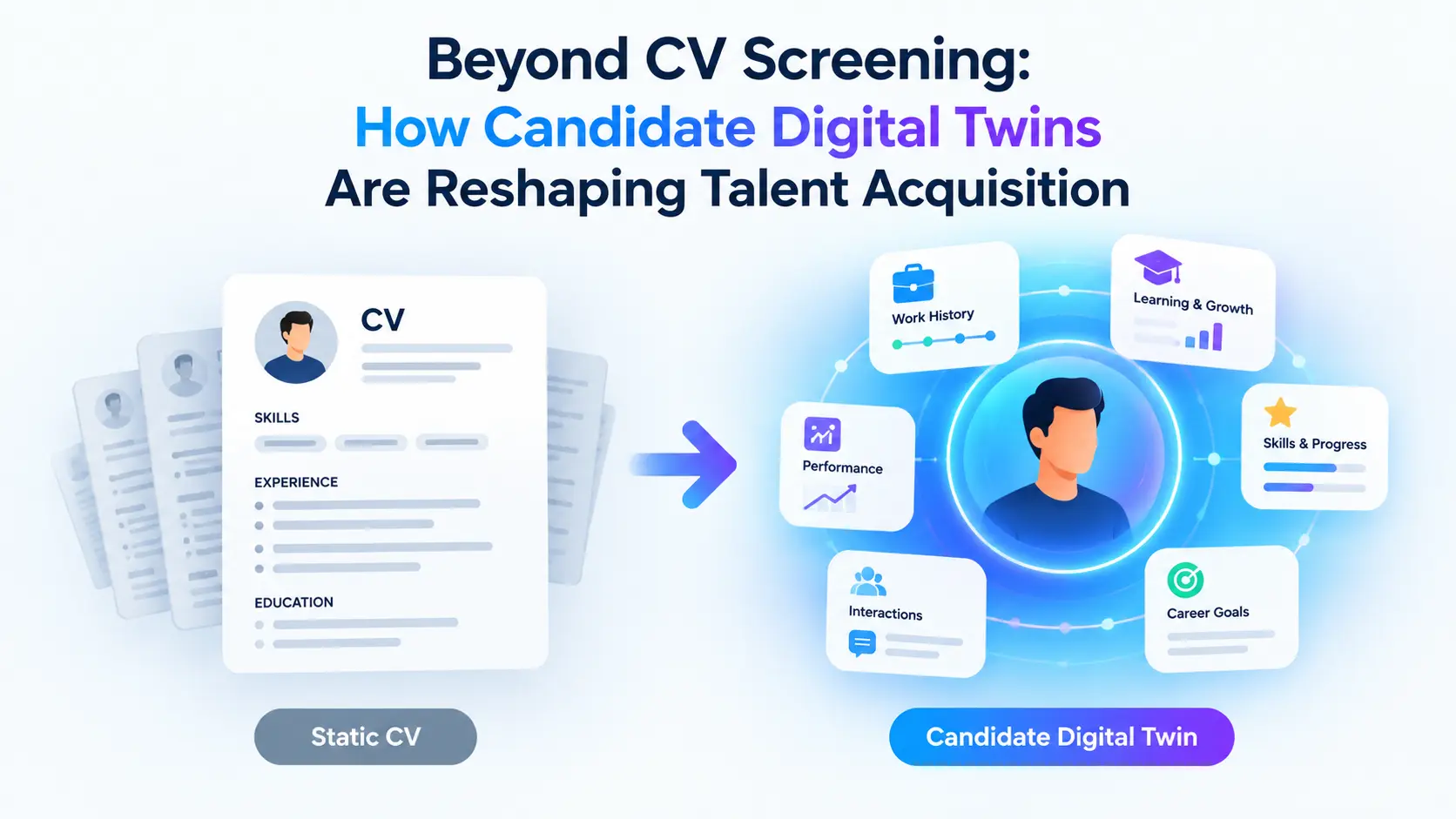
Digital twin technology is not a new concept. In manufacturing and healthcare, it creates dynamic virtual replicas of physical entities or systems using real-time data for simulation, monitoring, and optimization. Applied to talent acquisition, a Candidate Digital Twin is a continuously evolving model of a job seeker—not a static record.
What traditional ATS platforms store is a "candidate record"—a snapshot frozen at the moment of application, answering the question "who was this person when they applied?" A Candidate Digital Twin is a living model that answers: "Who is this person now, and where is their career trajectory pointing?"
The Core Distinction
| Dimension | Traditional Candidate Record | Candidate Digital Twin |
|---|---|---|
| Data freshness | Frozen at application | Continuously updated |
| Scope | Documented past (resume, cover letter) | Documented past + predicted future + behavioral signals |
| Learning loop | None—each hire is an isolated event | Closed loop—outcomes feed back into models |
| Primary question | "Does this person match the job description?" | "What would this person say yes to today, and would they succeed?" |
| Bias mitigation | Trained on who got hired | Trained on who succeeded after being hired |
| Temporal dimension | Single point in time | Longitudinal trajectory |
This is not a semantic nicety. It fundamentally changes what an organization can do with its talent data.
2. Why Current AI CV Screening Has Hit a Ceiling
Recent research paints a clear picture of an industry that has optimized the wrong thing.
Static Schemas Are Obsolete
Traditional Applicant Tracking Systems were designed around the resume as the "unit of truth." These systems have no native capability to store dynamic signals like career trajectory or evolving skill recency. The schema itself—built decades ago—cannot accommodate the data types that modern talent intelligence requires.
No Continuous Learning
Legacy systems treat each hire as an isolated event. There is no mechanism for successful outcomes to inform future candidate evaluation models. A company can hire 500 software engineers over five years, and its ATS will learn exactly nothing from which of those 500 succeeded, which left within six months, and which became top performers.
The Resume Freezes at Application
A candidate's skills and career trajectory continue to evolve long after the initial application. Yet their record remains static. A Java developer who applied two years ago may now be a machine learning engineer. A mid-level marketer may now be a VP. The system sees neither.
The "AI Doom Loop"
The Financial Times has reported on what it calls the "AI doom loop" of mass applications: candidates use AI to generate applications, companies use AI to screen them, and the result is signal degradation on both sides. The arms race has made it harder—not easier—to identify genuine fit. Moving to deeper, ongoing candidate models may be one path out of this degradation.
3. The Technical Architecture of a Candidate Digital Twin
Unlike current CV screening systems that process one-time submissions, a Candidate Digital Twin requires continuous data ingestion and model updates. The architecture needs to track several dimensions:
3.1 Skill Recency and Decay
The UNU prototype already demonstrates tracking whether skills are current or outdated, applying scoring multipliers that down-weight expired competencies. A Digital Twin extends this to ongoing monitoring: not just "did they have this skill when they applied," but "is this skill still relevant, and how recently have they used it?"
This matters because skill half-lives are shrinking. A framework learned in 2020 may be legacy by 2026. A static resume cannot capture this decay.
3.2 Career Trajectory Modeling
Moving beyond static job titles to predict where a candidate is heading—not just where they've been. This involves:
- Velocity metrics: How quickly has this person progressed through roles?
- Scope expansion: Are they taking on broader responsibilities?
- Domain shifts: Are they moving into adjacent or entirely new areas?
- Trajectory fit: Does their projected path align with the role's projected evolution?
A candidate who was "not a fit" for a senior role two years ago may be perfectly positioned today. A candidate who was a strong fit may have plateaued. Static screening cannot make this distinction.
3.3 Behavioral and Engagement Signals
How candidates interact with your employer brand, respond to outreach, and engage with your hiring process provides rich signal that a resume never captures:
- Response patterns: How quickly and enthusiastically do they respond to recruiter outreach?
- Content engagement: What articles, job postings, or company updates do they interact with?
- Application behavior: Do they apply selectively or broadly? Do they complete assessments?
- Network effects: Who do they engage with in your talent community?
These signals feed a predictive model of offer acceptance probability—a metric that early adopters report can improve acceptance rates by 12–18%.
3.4 The Data Pipeline Challenge
The technical challenge here is significant. A Candidate Digital Twin requires:
- Identity resolution: Matching candidate data across multiple touchpoints (applications, LinkedIn interactions, event attendance, email engagement) to a single evolving profile
- Consent management: Candidates must opt in to ongoing modeling, with clear value exchange
- Data freshness SLAs: Ensuring the model reflects current reality, not stale signals
- Model retraining cadence: Updating predictive models as new outcome data arrives
This is not a feature you bolt onto a legacy ATS. It requires rethinking the data layer entirely.
4. Three Capabilities Current CV Screening Cannot Deliver
The research identifies three concrete capabilities that a Digital Twin enables—capabilities that are simply impossible within the current paradigm.
4.1 Talent Rediscovery 2.0
When a new role opens, the system evaluates every past candidate's current trajectory against the role. This is fundamentally different from searching a static database:
- It surfaces people who were never a fit before but are now—and correctly demotes those who were once a fit but no longer are.
- It can identify "boomerang" candidates whose career progression now aligns perfectly with a new opening.
- It eliminates the "silver medalist" problem where strong candidates from past searches are forgotten because their record is frozen.
In practice, this means a company with 100,000 past applicants has a continuously refreshed talent pool of 100,000 current profiles, not 100,000 stale records.
4.2 Offer Acceptance Prediction
By combining behavioral engagement, career trajectory fit, and contextual signals from similar past candidates, the system can model the probability that a given candidate would accept an offer. Early adopters report 12–18% higher acceptance rates.
This is not about manipulation. It is about respecting candidates' time and intentions. If a candidate is unlikely to accept—because their trajectory points elsewhere, or their engagement signals are low—the system can prioritize outreach to candidates who are both qualified and genuinely interested.
4.3 Outcome-Based Bias Mitigation
This is perhaps the most significant contribution. Current AI CV screening models train on who got hired—which can embed historical bias. If a company historically hired mostly from certain demographics, the model learns to replicate that pattern.
A Digital Twin, by persisting long after the hiring decision, can train on who succeeded after being hired—measured by tenure, promotion velocity, and performance. This is a fundamental shift from auditing for bias retroactively to designing it out prospectively.
The distinction matters:
- Process transparency: "We can explain why this candidate was rejected" (current standard)
- Outcome-based fairness: "Our model is trained on what actually predicts success, not on who historically got hired" (Digital Twin standard)
As jurisdictions move toward requiring that AI hiring systems demonstrate outcome-based fairness, this capability will shift from competitive advantage to regulatory necessity. The Moka analysis suggests this will become a regulatory expectation within 24 months.
5. Governance and Explainability: The Hard Questions
The transition to Digital Twins raises governance questions that current frameworks are not equipped to answer.
5.1 How Do You Explain a Predictive Score?
Current AI CV screening explainability focuses on documented past: "This candidate scored highly because they have 5 years of Python experience and a relevant degree." A Digital Twin score might derive from a predictive model of a person's future trajectory: "This candidate scored highly because their career velocity, skill acquisition rate, and engagement patterns suggest they will be a top performer in this role within 18 months."
This is a different kind of explanation—probabilistic, forward-looking, and harder to communicate. The UNU prototype's principle of human-in-the-loop design, where the system explicitly informs rather than decides, becomes even more critical here.
5.2 Consent and Data Ethics
A Candidate Digital Twin requires ongoing data collection and modeling. This raises questions:
- What is the value exchange for candidates? (Better matches? Faster processes? Career insights?)
- How do candidates access, correct, or delete their twin?
- What happens when a candidate asks to be "forgotten"?
- How do you prevent the twin from becoming a surveillance tool?
These are not afterthoughts. They are design requirements.
5.3 The Transparency Paradox
There is a tension between model sophistication and explainability. A simple keyword-matching system is easy to explain but produces poor results. A Digital Twin with dozens of dynamic signals is more accurate but harder to explain. Regulators and candidates alike will demand both.
The resolution likely lies in tiered explainability: high-level factors for candidates ("your profile matches this role because of your trajectory in X and Y"), detailed factor weights for auditors, and full model access for regulators.
6. What This Means for Talent Acquisition Leaders
If the Candidate Digital Twin represents the next paradigm, what should talent acquisition leaders do today?
6.1 Audit Your Data Architecture
Ask hard questions about your current systems:
- Can your ATS store dynamic signals, or only static records?
- Is there a closed loop from hire outcome back to screening model?
- How fresh is your candidate data? Days? Months? Years?
If the answers are discouraging, you are not alone. Most legacy systems were not built for this.
6.2 Start with Talent Rediscovery
The lowest-risk, highest-value entry point is Talent Rediscovery 2.0. Rather than rebuilding your entire stack, you can layer a dynamic modeling capability on top of your existing ATS, starting with past candidates who opted in to future opportunities.
This delivers immediate value—surfacing overlooked candidates for open roles—while building the data infrastructure for more advanced capabilities.
6.3 Prepare for Outcome-Based Fairness Requirements
Even if regulation is not yet in your jurisdiction, the direction is clear. Start tracking post-hire outcomes (tenure, performance, promotion) and linking them back to screening decisions. This data will become the foundation of your fairness auditing—and your competitive advantage.
6.4 Design for Consent from Day One
Do not treat consent as a compliance checkbox. Build a genuine value exchange: candidates who opt in to ongoing modeling get better matches, faster processes, and career insights. Make it easy for them to access, correct, and delete their data. This is both ethical and practical—candidates who trust the system engage more deeply, which improves the model.
7. The Road Ahead: From Screening to Intelligence
The evolution of AI in hiring has followed a clear trajectory:
- Keyword matching (2000s): Boolean search on resumes
- Semantic understanding (2010s): NLP and embedding-based matching
- LLM-powered evaluation (early 2020s): Contextual understanding with explainability
- Multi-agent orchestration (mid-2020s): Coordinated AI agents handling different aspects of screening
- Candidate Digital Twins (emerging): Dynamic, longitudinal modeling of candidates as evolving entities
Each step has been an improvement, but the first four share a common limitation: they all operate on the resume as a static document. The Digital Twin breaks that constraint.
This does not mean resumes disappear. They remain a valuable data point—one signal among many. But they are no longer the unit of truth. The candidate—dynamic, evolving, multifaceted—becomes the unit of analysis.
The Competitive Imperative
For talent acquisition leaders, the question is not whether this transition will happen, but whether they will lead it or react to it. Early adopters are already reporting measurable gains: higher offer acceptance rates, faster time-to-fill for hard-to-fill roles, and improved quality-of-hire metrics.
The organizations that build Candidate Digital Twin capabilities today will have a compounding advantage. Every hire improves the model. Every outcome refines the prediction. Every candidate interaction enriches the twin. This is a data network effect that static screening systems can never replicate.
Conclusion: The Candidate Is Not a Document
The fundamental insight behind Candidate Digital Twins is simple but profound: a person is not a PDF.
A resume is a snapshot. A career is a movie. A CV screening system that analyzes the snapshot will always miss the story.
The next generation of talent intelligence will model the story—continuously, dynamically, and fairly. It will learn from outcomes, not just inputs. It will predict trajectory, not just match keywords. It will serve candidates as well as employers, creating a value exchange that makes the entire system more trustworthy and more effective.
The resume is dying. The Candidate Digital Twin is what comes next.
🔑 Key Takeaways
- Current AI CV screening analyzes a frozen snapshot—a fundamental limitation that no amount of model improvement can overcome.
- Candidate Digital Twins are dynamic, longitudinal models of candidates that evolve over time and learn from hiring outcomes.
- Three capabilities become possible: Talent Rediscovery 2.0, Offer Acceptance Prediction, and Outcome-Based Bias Mitigation.
- Governance requires new frameworks: tiered explainability, genuine consent, and outcome-based fairness auditing.
- The competitive advantage compounds: every hire, outcome, and interaction improves the model.
- The transition is coming: regulatory pressure and competitive dynamics will make Digital Twins the standard within 24–36 months.