
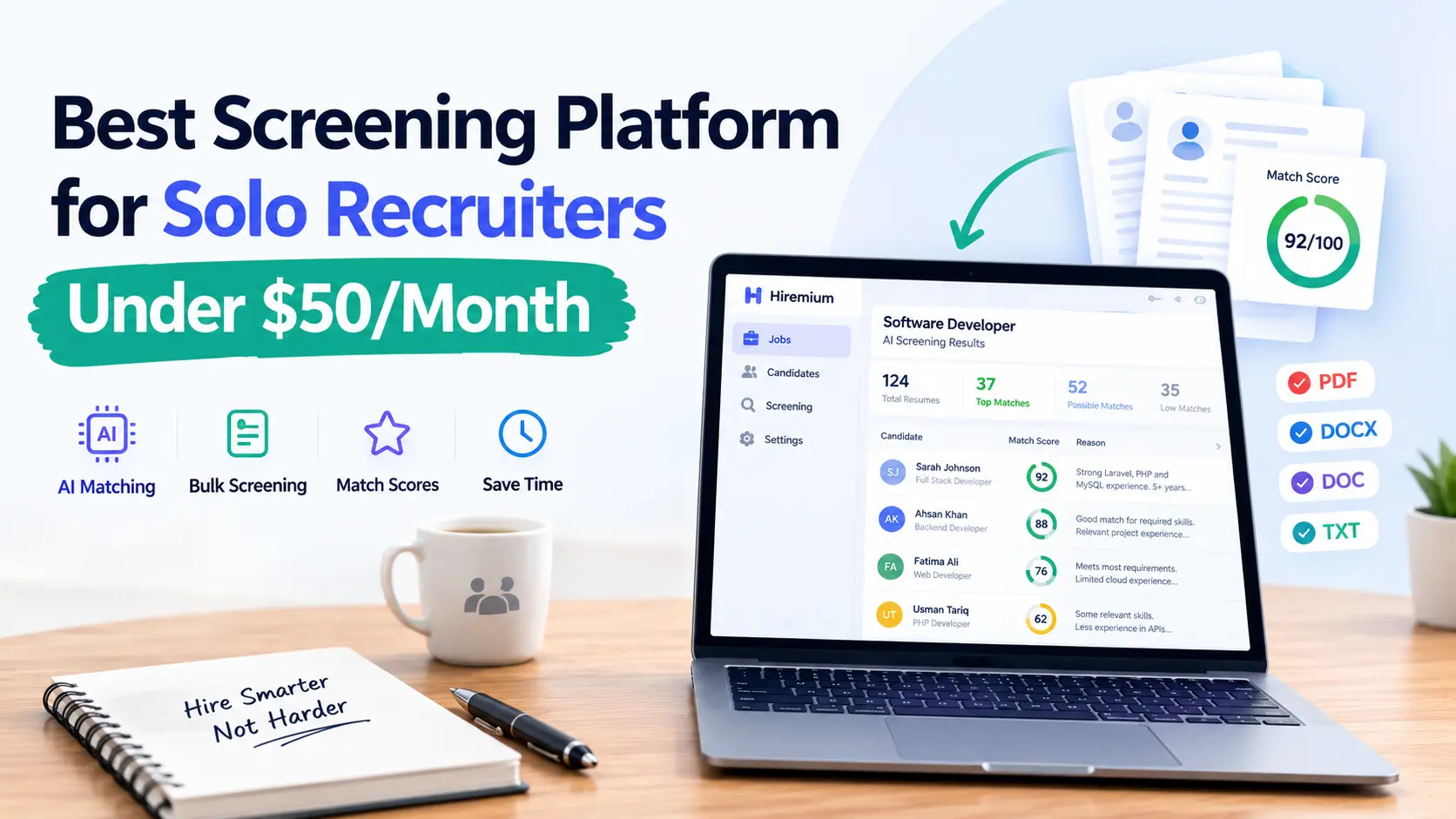
Finding affordable recruiting software can be difficult for solo recruiters. Many platforms are designed for larger HR teams and include features that independent recruiters may never use. This guide compares affordable recruiting and AI resume screening platforms for solo recruiters, with a focus on bulk resume screening, AI matching, candidate scoring and ease of use.
For an independent recruiter, the requirement can be much simpler than adopting an entire enterprise recruitment system.
You may simply need to upload a job description, upload a large number of resumes, let AI analyze the candidates and quickly identify the people worth reviewing more closely.
The recruitment software market now includes both full applicant tracking systems and specialized AI resume screening tools. Understanding the difference can help you avoid paying for features you do not actually need.
Quick Comparison: AI Screening Platforms Under $50/Month
| Platform | Starting price* | AI screening / matching | Bulk resumes | Main focus |
|---|---|---|---|---|
| Hiremium | See current pricing | Yes | Yes | AI resume screening |
| Manatal | $15/user/month annually | Yes | Yes | Full ATS + AI |
| Zoho Recruit | Free / paid plans | Yes on selected plans | Yes | Full ATS |
| Skima AI | Around $49/user/month annually | Yes | Yes | AI screening |
| ResumeScreening.ai | Free / low-cost plans | Yes | Yes | Resume screening |
| Workable | $299/month | Yes | Yes | Full recruiting platform |
*Prices and feature limits can change. Pricing may also vary depending on annual versus monthly billing, region, taxes, usage and plan. Always verify current pricing with the vendor before purchasing.
What Should a Solo Recruiter Look for in a Screening Platform?
Before choosing recruiting software, it helps to separate resume screening from recruitment management.
1. Resume-to-job matching
The software should understand the job description and compare each resume against the actual requirements of the position.
Instead of simply searching for individual keywords such as PHP, Laravel, WordPress or MySQL, AI matching can consider the candidate's broader experience, skills, seniority and relevance to the position.
2. Bulk resume screening
Bulk processing is one of the most important features for recruiters.
Screening one resume at a time does not solve the biggest problem when you receive 100, 200 or more applications.
A useful AI screening platform should allow you to upload multiple resumes and analyze them together.
3. Match scores
A numerical score can make a large candidate pool easier to work through.
4. Explanations
A score by itself is not particularly useful. Recruiters should be able to understand why a candidate received that score.
Example AI screening result
88/100 match
Strong Laravel and PHP experience with six years of backend development. Meets the required API and MySQL requirements. Limited experience with AWS compared with the job requirements.
5. Candidate ranking
When you have 150 resumes, you do not necessarily want to read 150 AI summaries. You want to quickly identify the candidates who deserve your attention first.
A useful screening system should make it easy to move from a large candidate pool to a manageable shortlist.
Best AI Screening Platforms for Solo Recruiters
1. Hiremium — AI Bulk Resume Screening
Hiremium is designed around a focused recruiting problem: helping recruiters screen large numbers of resumes against a job description.
Instead of requiring a recruiter to build an entire recruitment workflow before using AI, the workflow can start with two things:
Job description + resumes
The system can then analyze candidates and provide match scores, explanations and screening insights.
Typical Hiremium workflow
- Create or upload a job description.
- Upload multiple candidate resumes.
- Let the AI analyze the resumes.
- Generate candidate match scores.
- Review the reasons behind the scores.
- Focus your time on the strongest candidates.
- Continue with your normal interview and hiring process.
The goal is not to replace the recruiter. The goal is to reduce the amount of repetitive manual resume review and help recruiters prioritize where they spend their time.
2. Manatal — Affordable Full ATS With AI
Manatal is an established applicant tracking system for recruiters who want a broader recruitment platform rather than only a screening tool.
Manatal's Professional plan is currently listed at $15 per user/month when billed annually. The plan includes recruitment features such as resume parsing, candidate recommendations, automatic scoring and candidate summaries.
View Manatal's current pricing
Best suited for
- Independent recruiters who need an ATS
- Small recruitment agencies
- Recruiters managing multiple active jobs
- Recruiters who want candidate pipelines
- Users who want recruitment workflow features alongside AI
The trade-off is that you may be paying for many recruitment-management features when your immediate problem is simply screening resumes.
3. Zoho Recruit — Budget ATS Option
Zoho Recruit is another established applicant tracking system with a free plan and several paid recruitment plans.
Its plans include features for resume management, candidate sourcing, job management and recruitment workflows. AI functionality is available on selected plans.
View Zoho Recruit's current pricing
Best suited for
- Recruiters already using Zoho products
- Small businesses
- Recruiters who want a complete ATS
- Teams that need recruitment workflows
Like other full ATS products, Zoho Recruit is broader than a dedicated AI resume screening platform.
4. Skima AI — AI-Focused Screening
Skima AI focuses heavily on AI-assisted recruitment and candidate screening rather than attempting to provide every possible HR function.
Pricing and plan limits can change, so recruiters should check the vendor's current pricing before making a purchasing decision.
Best suited for: recruiters looking for AI-assisted candidate evaluation and screening.
5. Resume Screening Tools
Another category worth considering is dedicated resume screening software. These tools concentrate primarily on evaluating resumes against a job description instead of providing a complete applicant tracking system.
This can be attractive to independent recruiters because the workflow is straightforward:
Job description → resumes → AI analysis → shortlist
Free and low-cost tools exist in this category, but recruiters should compare their actual monthly resume limits, supported file types and AI capabilities before choosing one.
What About Workable?
Workable is a much larger recruitment platform and is useful as an example of why pricing matters for a solo recruiter.
Workable's Standard plan is currently listed at $299/month for organizations with 1–20 employees.
View Workable's current pricing
Workable can make sense for organizations looking for a broader recruiting platform, but it sits well above a $50/month budget.
Full ATS vs Dedicated AI Resume Screening
This is one of the most important decisions for a solo recruiter.
Full ATS
A full ATS typically provides:
- Candidate database
- Job management
- Hiring pipelines
- Career pages
- Job posting
- Candidate communication
- Interview management
- Reporting
- Team collaboration
- Resume parsing
- AI matching
Examples include platforms such as Manatal and Zoho Recruit.
Dedicated AI screening
A screening-focused product can concentrate on:
- Job description analysis
- Resume parsing
- Bulk resume upload
- Candidate matching
- Match scoring
- AI explanations
- Candidate ranking
- Screening insights
This approach can be attractive when your biggest problem is resume volume rather than managing every stage of the recruitment lifecycle.
How Much Should a Solo Recruiter Spend?
There is no universal recruiting software budget because hiring volume varies significantly between recruiters.
Someone hiring occasionally may not need another monthly subscription. A recruiter screening hundreds of resumes every month may save considerably more time from a dedicated AI screening platform.
Monthly software cost ÷ hours saved = approximate cost per hour saved.
For example, suppose an AI screening platform costs $30/month and saves you five hours of manual resume review.
That works out to:
$30 ÷ 5 hours = $6 per hour saved
If your recruiting time is worth considerably more than that, the software may provide positive value even if it does not replace any part of your hiring process.
Is AI Resume Screening Accurate Enough?
AI screening should be treated as a decision-support tool, not an automatic hiring decision-maker.
AI can help identify relevant candidates, but recruiters should still review shortlisted resumes and make the final decision.
A resume may:
- Use different terminology for the same skill
- Understate a candidate's abilities
- Contain incomplete information
- Include transferable experience
- Have formatting problems
- Describe an unusual career path
- Include skills that are not obvious from the job title
For example, an 82/100 score should not automatically mean that a candidate is "82% qualified."
Instead, it should mean that based on the available information and evaluation criteria, the candidate appears to have a strong match.
AI Resume Screening and Hiring Bias
Recruiters should also use AI screening with appropriate human oversight.
AI systems can reproduce problems in the data, instructions or criteria used to evaluate candidates.
Recruiters should periodically review:
- Which candidates are being rejected
- Whether relevant qualifications are being missed
- Whether irrelevant factors influence results
- Whether screening criteria accurately reflect the job
- Whether candidates with nontraditional backgrounds are being filtered out
A practical approach is to use AI to prioritize human attention, rather than automatically reject candidates without review.
What Makes a Good $50-or-Less Screening Tool?
If you're evaluating tools specifically for solo recruiting, use this checklist.
Must-have features
- Bulk resume upload
- PDF resume support
- DOC/DOCX support
- Job description analysis
- AI candidate matching
- Candidate score
- Explanation for the score
- Candidate ranking
- Search and filtering
- Reasonable monthly usage limits
- Export or download options
- Clear data privacy information
Nice-to-have features
- CSV candidate import
- ZIP resume upload
- Duplicate detection
- Candidate database
- Custom screening criteria
- Interview questions
- Candidate summaries
- ATS integrations
- API access
Which Type of Platform Is Right for You?
| Your requirement | Consider |
|---|---|
| I need a complete ATS | Manatal / Zoho Recruit |
| I already have an ATS | AI screening layer |
| I mainly need resume screening | Dedicated AI screening platform |
| I receive hundreds of resumes | Bulk screening platform |
| I occasionally hire | Free or low-cost screening tools |
| I need sourcing + ATS + AI | Full recruitment platform |
| I want to spend less than $50/month | Budget ATS or dedicated screener |
Why Solo Recruiters Are an Interesting Market for AI Screening
Large recruitment platforms often include many features because they need to support organizations with complex hiring processes.
Independent recruiters often have a different problem: they need to move quickly.
If a recruiter receives 150 applications for a position, manually opening and evaluating every resume can consume hours.
AI can potentially reduce that first-pass workload by extracting information, comparing candidates against job requirements and bringing relevant profiles to the recruiter's attention.
"AI replaces the recruiter."
The practical goal is:
"AI helps the recruiter get from 150 resumes to a manageable shortlist faster."
Hiremium: AI Screening for Recruiters Who Mainly Need Resume Matching
If your primary problem is screening a large number of resumes, Hiremium takes a focused approach.
Rather than requiring you to replace your entire recruitment workflow, Hiremium focuses on the part that can consume significant manual time: initial candidate screening.
The workflow is straightforward:
Job → Resumes → AI analysis → Match scores → Reasons → Shortlist
This can be particularly useful for independent recruiters, freelance recruiters and small staffing businesses that already have their own processes for communicating with clients and candidates.
The recruiter remains responsible for the final hiring decision. AI is used to reduce repetitive resume review and help prioritize candidates for closer human evaluation.
Start with one real job
A practical way to evaluate an AI screening platform is to test it against a real hiring requirement.
Take:
- One real job description
- 20–100 resumes
- Your existing shortlist or recruiter judgment
Then compare the results.
- Did the AI identify candidates you already considered strong?
- Did it miss obviously relevant candidates?
- Were the explanations useful?
- Did the ranking save you time?
- Could you understand why candidates received their scores?
This is a much more useful test than simply comparing feature lists.
Screen Your Next Batch of Resumes With AI
Upload a job description and your candidate resumes, then use AI matching to identify which candidates deserve your attention first.
Try HiremiumFrequently Asked Questions
What is the best resume screening software for a solo recruiter?
The answer depends on whether you need a complete ATS or primarily AI resume screening. Manatal and Zoho Recruit are examples of affordable ATS platforms, while dedicated screening products focus more directly on resume evaluation and candidate matching.
Is there AI resume screening software under $50 per month?
Yes. Several products offer free or paid options below $50 per month, although the exact feature limits vary. Pricing should always be checked on the vendor's current pricing page.
Can AI screen hundreds of resumes?
Many AI recruitment platforms support bulk resume processing, but practical limits depend on the platform's plan, usage limits, file size restrictions and AI credits.
Always check the actual monthly resume allowance rather than looking only at the subscription price.
Is AI resume screening better than manually reading resumes?
AI and manual screening solve different parts of the problem. AI can help process large candidate volumes and prioritize resumes, while human recruiters can evaluate context, communication, motivation, transferable skills and other factors that may not be fully represented in a resume.
A hybrid approach is generally more appropriate than treating an AI score as the final hiring decision.
Is a full ATS necessary for a solo recruiter?
Not necessarily. If you need candidate pipelines, job posting, interview scheduling and candidate databases, an ATS can be useful. If your primary problem is reviewing large numbers of resumes, a dedicated AI screening platform may be sufficient.
How much does AI recruitment software cost?
Pricing varies widely. Current examples range from free plans and low-cost per-user products to several hundred dollars per month for broader recruitment platforms.
The important factors are not just the monthly price but also the number of resumes you can process, AI credits, candidate limits and included features.
Final Thoughts
For a solo recruiter, the cheapest recruiting platform isn't necessarily the one with the lowest subscription price.
The more important question is:
If you need an entire applicant tracking system, platforms such as Manatal and Zoho Recruit provide broader recruitment functionality.
If your main problem is screening large numbers of resumes, however, a focused AI screening workflow may be more relevant.
The ideal setup is one where you can upload a job description, process your candidate pool, understand why candidates match and quickly move from hundreds of applications to a manageable shortlist, while keeping the recruiter in control of the final decision.
Last reviewed: October 2026